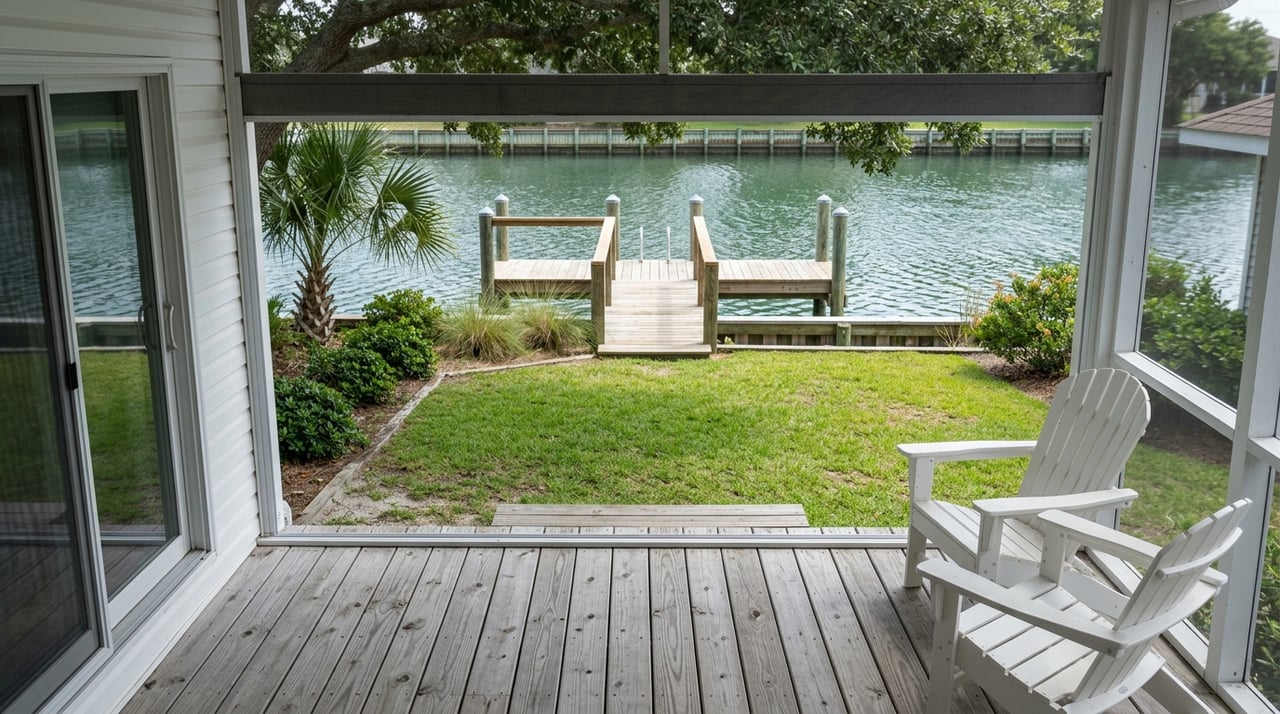
Wondering whether Cedar Point or Cape Carteret is the better match for your coastal lifestyle? If you are narrowing your home search in western Carteret County, this is one of the most practical comparisons to make. Both towns give you easy access to the water and the bridge to Emerald Isle, but they live a little differently day to day. This guide will help you compare setting, housing, amenities, and everyday convenience so you can choose with more confidence. Let’s dive in.
Cedar Point and Cape Carteret at a glance
Cedar Point and Cape Carteret are neighboring towns in western Carteret County, and both sit along the main corridor leading toward Emerald Isle. They are similar in size, but not identical in feel. Recent ACS-based profiles show Cedar Point with 1,917 residents on 2.2 square miles and Cape Carteret with 2,703 residents on 2.5 square miles.
The income and age profiles are also fairly close. Median household income is reported at $98,750 in Cedar Point and $86,136 in Cape Carteret, and both towns have median ages in the mid-40s. In practical terms, that means you are comparing two small, established coastal communities rather than two places with completely different market identities.
A helpful way to think about the choice is this: Cedar Point tends to feel more recreation-forward, while Cape Carteret tends to feel more centered around neighborhoods and daily services. That is a lifestyle read based on town descriptions and planning materials, but it is a useful starting point when you begin your search.
Cedar Point coastal setting
Cedar Point sits on a peninsula bordered by the Intracoastal Waterway, White Oak River, and Pettiford Creek. The town also notes views of Bogue Sound, the Atlantic Intracoastal Waterway, and the White Oak River. If being surrounded by water is part of your vision for coastal living, Cedar Point checks that box in a very visible way.
Its planning background also points to a stronger seasonal rhythm. The town has noted that summer population rises because of secondary residences and campgrounds. If you like a setting that feels especially coastal and a bit more seasonal in tone, Cedar Point may stand out to you.
Cape Carteret coastal setting
Cape Carteret is also closely tied to the water, but the setting feels a bit more mainland-residential. The town reports nearly 8 miles of waterfront along Bogue Sound, Deer Creek, canals, and Pettiford Creek. It also sits just across the bridge from Bogue Banks and the Atlantic Ocean.
That means you still get strong water access and coastal proximity, but often with a more centralized town pattern. For many buyers, that balance can feel practical because you are close to the shore experience without giving up the convenience of a more connected local layout.
Housing character in each town
Housing style is one of the clearest differences between these two towns. If you want a more traditional detached-home environment, Cape Carteret usually reads that way more consistently. If you want a broader mix of housing types or a setting with more seasonal-use influence, Cedar Point may offer a better match.
Cape Carteret housing profile
Cape Carteret’s planning materials describe the town as primarily low-density residential, with detached single-family homes at about 1 to 2 dwelling units per acre. In the town’s 2019 ACS snapshot, over 88% of dwelling units were single-family, less than 1% were multifamily, and 12% were manufactured homes.
Census Reporter’s 2024 5-year profile shows 1,312 housing units, 80% owner-occupied units, and 95% single-unit structures. The median owner-occupied home value is listed at $375,700. If you are looking for a more uniform single-family housing stock, Cape Carteret presents a strong case.
Cedar Point housing profile
Cedar Point has a more mixed housing picture. The town’s 2024 land-use materials say single-family homes are spread throughout town, with many in subdivisions, but there are also limited-scale multifamily developments. Existing core areas also include mobile-home parks and RV parks.
Census Reporter’s 2024 5-year profile shows 1,227 housing units, with a median owner-occupied home value of $423,700. The town’s planning materials also describe Cedar Point as strongly coastal in character, with summer population growth tied to secondary residences and campgrounds. That combination can appeal to buyers who want flexibility in property type or who are drawn to a more seasonal coastal atmosphere.
Daily convenience and amenities
When buyers compare these towns, daily convenience is often the deciding factor. Both offer access to outdoor recreation and coastal living, but the experience is not exactly the same. One town leans more into errands and connected services, while the other leans more into parks and recreation.
Cape Carteret daily convenience
Cape Carteret has the stronger in-town convenience profile based on town descriptions. Its commercial core along NC 24 includes retail, restaurants, services, and amusements. If you want more of your day-to-day needs closer to home, that can be a meaningful advantage.
The town also highlights the Cape Carteret Trail, a 3.4-mile multi-use path along NC 58, NC 24, and Taylor Notion Road. The trail connects residents to the main commercial area, the Western Carteret Library, and White Oak Elementary School. Cape Carteret also notes a public boat ramp, kayak launch, four additional town parks, and Star Hill Golf Course.
Cedar Point recreation focus
Cedar Point’s amenity mix is more centered on outdoor recreation and waterfront experiences. Boathouse Creek Park is a 56-acre waterfront park with walking trails, kayaking, fishing, shoreline views, and protected wetlands. For buyers who picture free time on the water or in nature, that is a major lifestyle feature.
The Cedar Point Recreation Area in Croatan National Forest adds a small-craft boat ramp, fishing pier, a 2-mile canoe and kayak loop, and a campground. Western Park provides additional athletic-field space, and the town’s CedarFest event is centered on Boathouse Creek Park. If your ideal day involves launching a kayak, spending time near the water, or using local park space often, Cedar Point may feel especially appealing.
Commuting and getting around
Both towns are still largely car-oriented, so driving will be part of daily life in either location. Even so, there are a few practical differences worth knowing if convenience and mobility matter to you. These details may not make the decision for you, but they can shape how each town feels over time.
Census Reporter’s 2024 5-year data show mean commute times of 25.1 minutes in Cape Carteret and 25.9 minutes in Cedar Point. The same data show 86% of Cape Carteret workers and 81% of Cedar Point workers drive alone, while 7% of Cape Carteret workers and 13% of Cedar Point workers work from home. In short, both places are commuter-friendly in the sense that residents are used to driving, but neither functions as a highly walkable urban environment.
Cape Carteret has a slight edge in pedestrian convenience because it already has a trail spine connecting key destinations. Cedar Point’s transportation planning materials call for more pedestrian amenities, a comprehensive sidewalk plan, and better connections to important destinations. If being able to move around town on foot or by bike is part of your lifestyle, Cape Carteret currently offers a more built-out framework.
Cedar Point also has a stronger connection to bridge-corridor traffic. The town’s planning packet says Highway 58 is the primary access point for Emerald Isle, and Cedar Point Boulevard carries about 32,000 cars per day. That can make Cedar Point especially sensitive to bridge traffic and peak-season congestion.
Which town fits your lifestyle?
If your top priority is a more central mainland neighborhood feel with stronger day-to-day convenience, Cape Carteret may be the better fit. It offers a more consistent detached-home pattern, a commercial core for errands and services, and a trail network that helps connect some of the town’s main destinations.
If your top priority is a recreation-first coastal setting, Cedar Point may be the better match. Its peninsula location, strong park system, and broad access to paddling, boating, fishing, and waterfront views give it a distinctly outdoor feel. It also offers a somewhat broader housing mix and a stronger seasonal-coastal character.
For many buyers, the right answer comes down to how you want your days to feel. Do you want a town where convenience and neighborhood structure lead the experience, or one where water access and recreation shape it more directly? Once you answer that, your choice usually becomes much clearer.
If you are comparing Cedar Point and Cape Carteret and want guidance that is specific to your goals, budget, and timeline, Linda Folger can help you sort through the details and find the right fit on the Crystal Coast.
FAQs
How does Cedar Point compare to Cape Carteret for water access?
- Cedar Point is defined by its peninsula setting near the Intracoastal Waterway, White Oak River, and Pettiford Creek, while Cape Carteret also has extensive waterfront, including nearly 8 miles along Bogue Sound, Deer Creek, canals, and Pettiford Creek.
Which town has more single-family homes, Cedar Point or Cape Carteret?
- Cape Carteret has the more uniformly single-family housing stock, with planning materials and ACS-based data showing a strong concentration of detached homes.
Is Cedar Point or Cape Carteret better for daily convenience?
- Cape Carteret has the stronger in-town convenience profile, with a commercial core, local services, restaurants, and a trail that connects several everyday destinations.
What makes Cedar Point appealing for coastal recreation?
- Cedar Point stands out for Boathouse Creek Park, the Cedar Point Recreation Area in Croatan National Forest, water access, fishing, kayaking, and a stronger recreation-focused coastal feel.
Are Cedar Point and Cape Carteret similar for commuting?
- Yes, both are largely car-oriented communities with similar mean commute times, though Cape Carteret has a slight edge in pedestrian connectivity because of its existing multi-use trail network.